Signed in as:
filler@godaddy.com

To enable continuity in the knowledge of the health and abundance of the Northern Resident killer whale population by activating stable funding for annual population monitoring efforts. While Nature Legacy funds have recently been renewed in Canada discussions are currently underway to realign funding priorities in accordance with the government’s policies and directives. It is within this broader context that uncertainty has emerged regarding the continued support for long-standing monitoring initiatives. As a result, there is growing concern about the continuity of funding for the NRKW census, and consequently, about the future of this critical long-term dataset.
Who are the Northern Resident Orcas?
The northern resident orcas are a growing but closed population of 375 individuals that range through coastal waters between western Washington and southeastern Alaska. They travel in extremely cohesive family groups, live for many decades, and have sophisticated communication habits that allow them to transfer cultural behaviors and traditional knowledge.
How do we know so much about them?
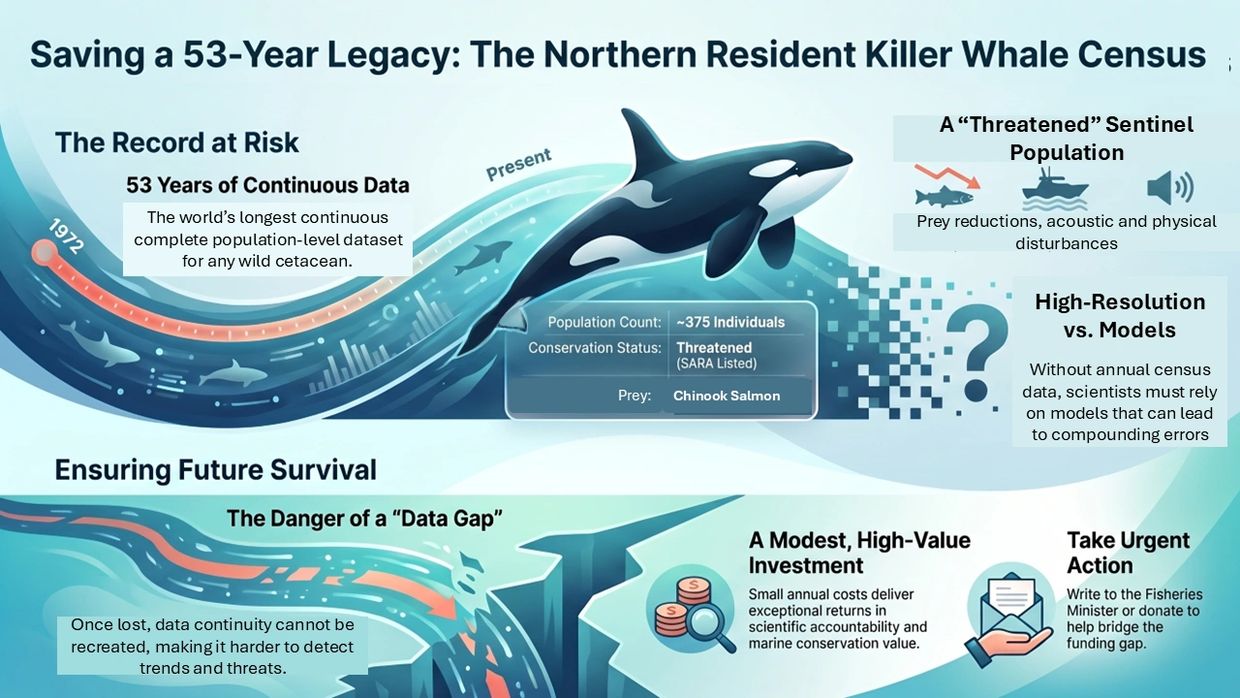
Northern Residents are the first killer whales to be studied in the wild and have been censused with photo-ID each year since 1972 resulting in the longest continuous population level dataset of any wild cetacean. This dataset has resulted in hundreds of scientific publications providing an incredible baseline of knowledge about the population which has highlighted the need for and helped inform conservation efforts.
What is our connection to them?
Killer whales throughout the range of the Northern Resident population have likely co-existed with and inspired coastal peoples since the onset of the Holocene. They adorn First Nations art and play an important role in modern society, appearing on statues, logos and in many films and books. Northern Residents are foundational to much of our connection with orcas in North America, having been captured for and displayed in oceanariums since the 1960s and focal to development in the 1970s of what is now a multi-billion dollar global whale-watch industry.
What threats do they face?
The health, survival, body size and fecundity of Northern Residents are correlated with the availability and size of their preferred prey, Chinook salmon. They are also impacted by acute and chronic acoustic disturbance from vessel traffic, bioaccumulation of contaminants, vessel strikes, entanglement and ingestion of fishing gear, as well as directed harm from fishers. These threats, combined with relatively small population size and low reproductive rates led to this population being listed as Threatened by the Committee on the Status of Endangered Wildlife in Canada (COSEWIC) in 2001 and subsequently under Canada’s Species at Risk Act (SARA).
What is being done to protect them?
The Canadian government has taken several measures to improve habitat for Northern Resident killer whales including legislating and enforcing a coast-wide 200 metre approach distance. Many measures to protect Southern Residents also benefit Northern Residents such because they target the same prey species, Chinook salmon. Allocations and catch areas for this species for sports and commercial fishers have been reduced and efforts to restore Chinook salmon spawning habitat have been implemented in many watersheds. Furthermore, the Canadian government has allocated up to $200K for annual population censusing of Northern Resident killer whales, up until now.
Why do they matter?
Northern Resident killer whales are a sentinel population, indicating the health of our oceans and guiding efforts that conserve not only them, but improve the entire marine ecosystem from the bottom up. For example, they can and do act as both a proxy and control for the endangered Southern Resident killer whales, thereby guiding accuracy in their management and conservation efforts. Perhaps, more importantly, the Northern Residents are symbolic of how human and orca societies can sustainably co-exist and co-evolve under proper management, thereby providing Canadians and the rest of the world with a model for what informed marine conservation looks like.
What is lost if annual Northern Resident census efforts are reduced or ceased?
Without annual efforts to monitor Northern Resident killer whales a globally unprecedented 53 year-long continuity in data and knowledge becomes broken for the first time. High resolution and stability in this dataset over the long-term is foundational to all past, present and future conservation efforts directed at Northern Resident killer whales because without these things no one would know or care how many whales are in this population, where they are, what they are doing, and if their numbers are increasing, stable, or declining. Population models using lower resolution data can help answer some of these questions but rely on assumptions that result in errors that can compound over time. They also fail to identify trends in risks, demographics or habitat use patterns exhibited in specific regions or subsets of the population making it difficult to predict, identify or respond to unforeseen changes in population level health or behaviours. Accordingly, a consistently high-resolution dataset is the only thing that allows us to measure population risks and the efficacy of conservation efforts directed at mitigating them.
What you can do?
We have identified three things that will immediately help encourage stability in long-term population level monitoring of Northern Resident killer whales.
1. Write a letter to Canadian Fisheries Minister Honourable Joanne Thompson, encouraging her to allocate stable annual funding for the Northern Resident killer whale census. Feel free to use ours as a template but please keep us in the loop by CCing info@baycetology.org and/or tagging us in comms about this on your socials.
2. Support our ability to help fill the data gap by making lump sum, legacy or monthly donations to Bay Cetology. We are based in Northern Resident killer whale critical habitat and with your support become enabled to make more consistent and meaningful contributions to this important monitoring program.
3. Submit your own identification photos of Northern Resident killer whales from 2026 onwards to the Northern Resident killer whale page at finwave which has been designed to link directly to the master encounter database historically maintained by DFO since 1973.